Physical Address
304 North Cardinal St.
Dorchester Center, MA 02124
Physical Address
304 North Cardinal St.
Dorchester Center, MA 02124

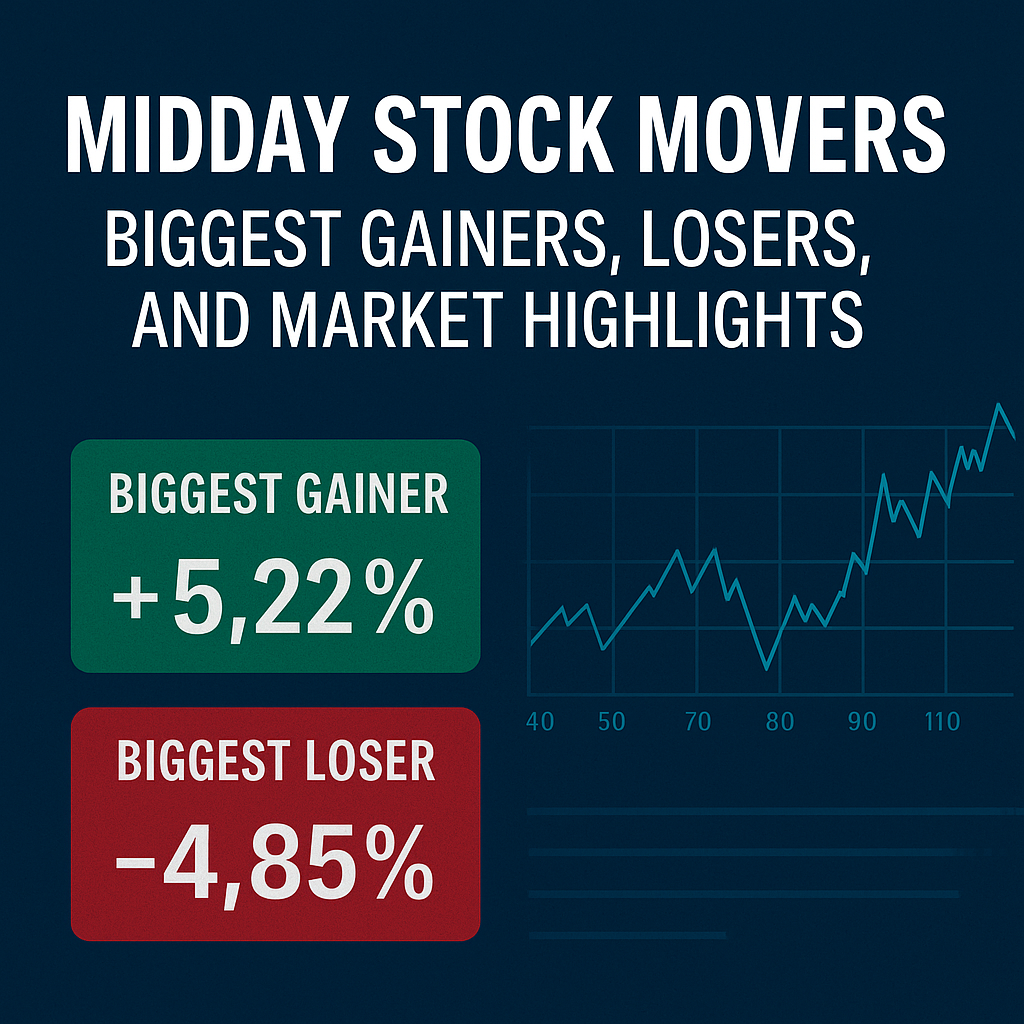
Midday trading often brings a surge of activity as investors react to breaking news, policy changes, earnings announcements, and analyst calls. On this trading day, a mix of corporate updates, government tariffs, and international deals pushed several well-known companies sharply higher or lower. This article provides a neutral look at the Midday Stock Movers and Market Highlights, including the Top Midday Stock Gainers and Losers, key industry shifts, and what these developments mean for broader market sentiment.
Boeing’s shares advanced more than 4% after a blockbuster announcement from Turkish Airlines. The carrier confirmed an order of 75 Boeing 787 aircraft and a plan to purchase 150 additional 737 MAX planes. The deal coincided with a meeting between Turkey’s President Tayyip Erdogan and President Donald Trump. In a separate development, the Federal Aviation Administration (FAA) said it would allow Boeing limited delegation to issue airworthiness certificates for certain 737 MAX and 787 airplanes. These certificates confirm aircraft safety standards, providing confidence in Boeing’s production pipeline.
Shares of truck manufacturer Paccar jumped 5% after President Trump announced a 25% tariff on imported heavy trucks, effective October 1. As the maker of Peterbilt trucks, Paccar is expected to benefit from reduced competition against imports, strengthening its position in the domestic trucking industry.
Intel rose 4% following reports that the company approached Apple, Taiwan Semiconductor, and others about possible investment opportunities. The news highlighted Intel’s push to restructure and regain competitiveness in a rapidly shifting semiconductor landscape.
Mirion Technologies surged 12% after JPMorgan initiated coverage with an “overweight” rating and a $28 price target. Investors were further encouraged by a report that the Department of Energy may allocate $900 million to domestic uranium enrichment—a move that would support demand for Mirion’s radiation safety technologies.
Furniture companies faced selling pressure after the announcement of a 30% tariff on upholstered furniture. RH dropped 4%, while Williams-Sonoma slid 1%. Higher costs for imported goods are expected to weigh on the sector, though domestic-oriented manufacturers may find some relief.
U.S. pharmaceutical companies experienced mixed moves. Trump announced a 100% tariff on branded, patented drugs entering the country but exempted firms investing in U.S. manufacturing. Eli Lilly and Merck both added about 1%, while Novo Nordisk slipped 2% due to its reliance on international supply chains.
Cabinet makers MasterBrand and American Woodmark each rallied over 5%. Both companies, which generate more than 95% of revenue from U.S. operations, are poised to benefit from a proposed 50% tariff on cabinet imports.
At midday, the broader market displayed a mixed tone:
The biggest gainers included Paccar, Boeing, Mirion Technologies, and Perpetua Resources. Notable losers were Concentrix, RH, Williams-Sonoma, and CleanSpark.
Midday volatility often stems from breaking news, government announcements, earnings releases, or analyst reports. These updates can significantly shift investor sentiment within a few hours.
Industries most impacted were industrials (aviation, trucking, manufacturing), pharmaceuticals, semiconductors, and consumer retail (furniture and wholesale).
These short-term movements highlight how quickly markets respond to policy changes and news events. While they provide trading opportunities, long-term investment decisions should consider broader fundamentals.
The Midday Stock Movers and Market Highlights reflected a trading day shaped by tariffs, corporate news, and shifting analyst opinions. While industrial companies and domestic manufacturers enjoyed gains, several global sectors experienced pressure. Midday updates provide valuable snapshots of investor sentiment, but they also underline the fast-changing nature of markets.